Trekking poles are the cheapest thing that genuinely changes a day in the mountains. A 1999 study measured their effect on the knees going downhill: between 12 and 25 percent less pressure. The rest you feel without measuring, crossing water, on scree and in the fourth hour of walking. This guide covers what they are made of, which locking system is worth the money, what length you need, what they cost in Romania, and which Bucovina trails really call for them.
The most quoted figure on the subject comes from a paper published in 1999 in Journal of Sports Sciences: going downhill, poles cut the compression and shear forces in the knee by between 12 and 25 percent. On the Pietrele Doamnei, where you drop 600 metres over scree in under an hour, you feel the difference the next day.
The other benefits are harder to measure cleanly, but anyone who walks with poles for a week can see them:
Balance on loose ground. Four points of contact instead of two, on scree, on wet roots and when crossing water. That is why even people with perfect knees use them.
Push on the climb. The arms take a share of the work. Not much, but over 1,200 metres of ascent it adds up.
Rhythm. A pole sets a cadence, and cadence keeps the breathing steady. You walk faster without feeling it.
Swollen hands. Walk four hours with your arms hanging and your fingers swell. With poles, they do not.
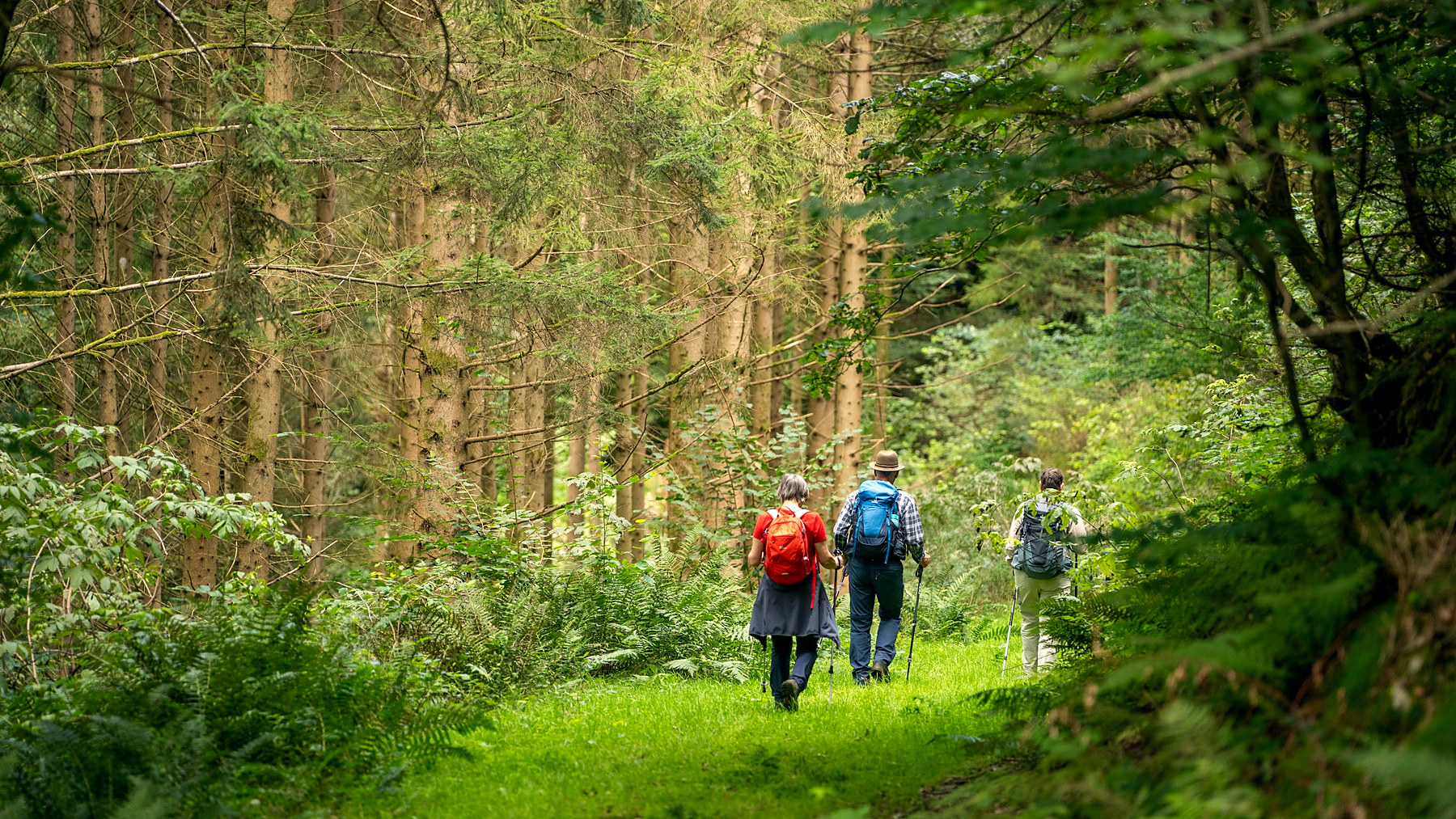
And one thing rarely said: on the Rarău and the Giumalău, where the path goes through dwarf pine and ferns as tall as a person, the pole feels the ground ahead. Holes between rocks and hidden roots are the number one cause of twisted ankles.
Four points of contactOn soft ground, among roots and ferns, the pole feels the way ahead of your foot.
This is the first choice and the only one that really matters to the budget.
Aluminium
The alloy used in serious poles is 7075-T6, the same one used in aviation. The cheapest, 6061-T6, is a little softer and heavier. A good aluminium pole weighs 200 to 250 grams.
The advantage that counts on the mountain: aluminium bends, it does not snap. If a rock falls on it or you catch it between stones, you are left with a bent but usable pole. With carbon you are left with two pieces.
Carbon
Lighter by 80 to 150 grams a pair and far stiffer, so it passes fewer vibrations into the wrists. Good carbon pairs come in under 300 grams.
The weak point is a sideways blow. Carbon fibre takes axial compression extraordinarily well, but it cracks under a point impact. On scree trails, where poles get wedged between rocks, that matters.
In short: if you walk a few times a year in Bucovina, buy aluminium and do not look back. Carbon earns its price on long days with a heavy pack, where every hundred grams tells.
This is where the money shows. There are three kinds, and the difference between them matters more than the material.
External lever clamp
Called FlickLock la Black Diamond, SpeedLock at Leki, „external lock” at Forclaz. A lever that grips the tube from outside. It adjusts with gloves on, and when it starts slipping you tighten it with a screwdriver. It does not fail on the trail.
This is the one you want. If you get to pick one criterion when buying, this is it.
Push-pin
A metal button that clicks into a hole. Simple, reliable, cheap. The drawback: fixed steps, usually every 5 centimetres, so you never quite hit your length. Common on entry-level poles.
Twist lock
You twist the tube to squeeze a plastic plug inside it. Cheap and clean to look at, but it slips when you lean on it hard, especially in the wet, and it is impossible to adjust with gloves. Almost every very cheap marketplace model uses it. Avoid it.
Cork: the best for long summer days. It takes up sweat, moulds to your hand over time and never turns slippery. The most expensive.
EVA foam: soft, light, absorbent. It wears faster, but at that price it is no tragedy. The right choice for most people.
Rubber or plastic: found on cheap models. It raises blisters in summer, but it is good in winter, because it does not soak up water that then freezes.
Look for the grip extension, the strip of foam below it, 10 to 15 centimetres long. On a steep climb you grab the pole lower down without stopping to adjust it. It is the detail that separates a proper pole from a stick.
Strap
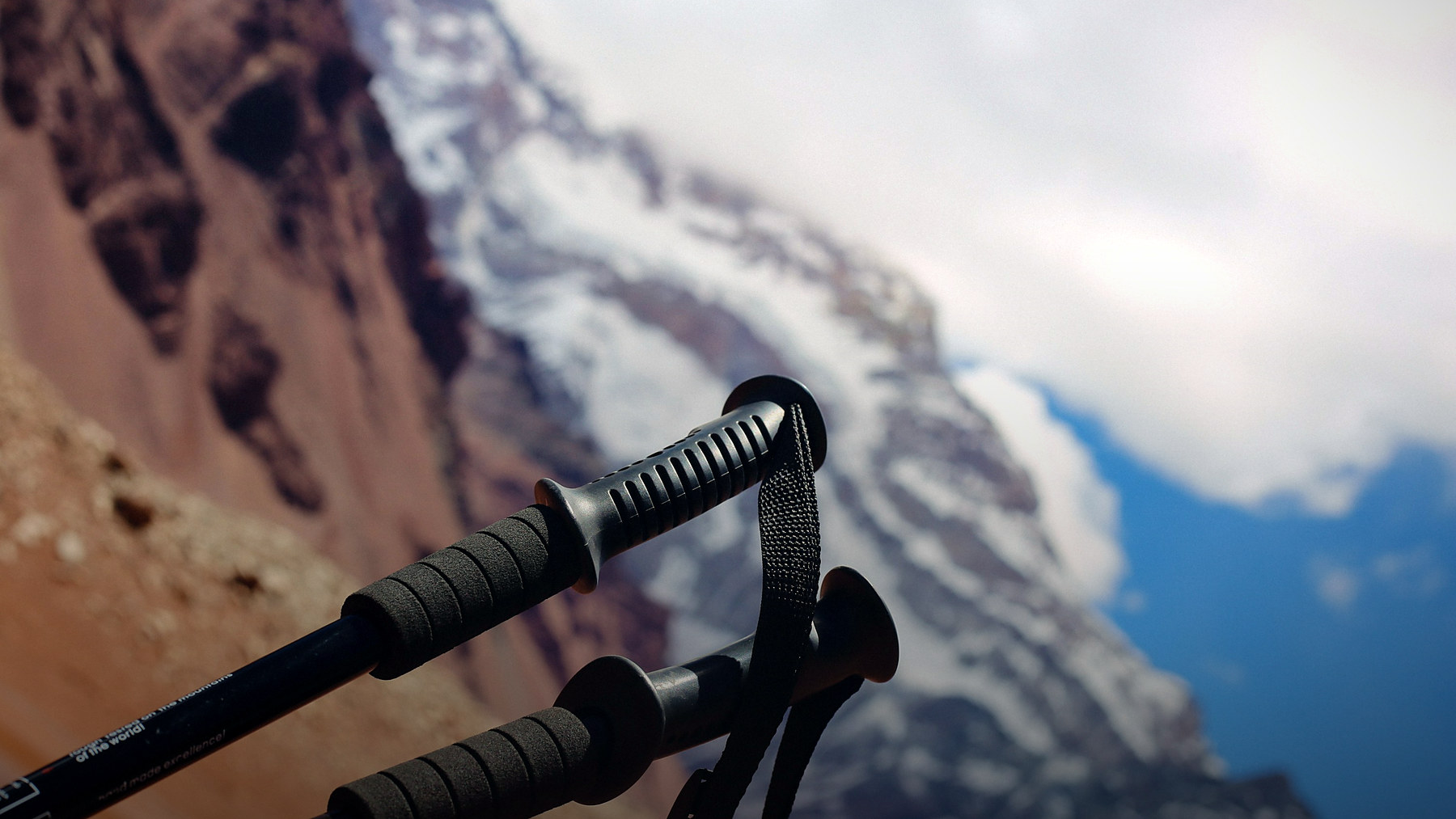
You hold it like this: your hand goes into the loop from below, then takes the grip over the strap. That way the weight sits on the strap, not on your fingers, and the palm stays relaxed for hours. Nine out of ten people I see on the trail hold it the other way round.
Tip
Din tungsten or carbide, not plain steel. It bites into rock and ice and blunts ten times more slowly. Over it goes the rubber cap, for tarmac and for carrying.
Baskets
The disc near the tip. The small summer one stops the pole sinking into mud. The big winter one keeps it above the snow. Check when buying that they can be swapped: on the cheapest models they are fixed.
Telescopic, three sections sliding into one another. Continuous adjustment, tougher, packs down to 60 to 70 centimetres. The standard choice for hiking.
Folding, tent-pole style, with a cable inside. It packs down to 35 to 40 centimetres, so it goes inside the rucksack instead of hanging off it. Dearer and with less adjustment.
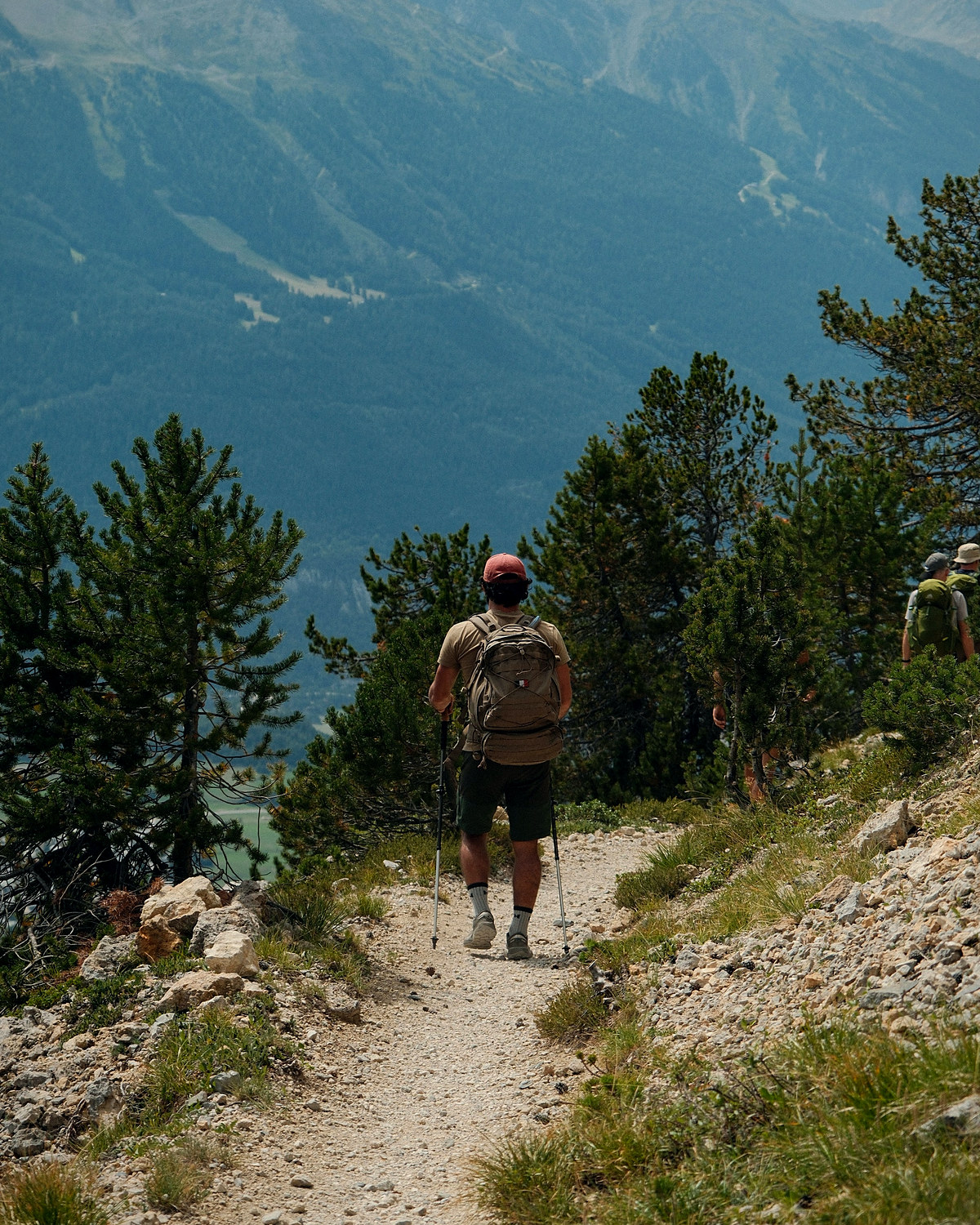
The length changes as you walkGoing down, with the poles lengthened, the weight moves from the knees into the arms.
There is one rule and you can check it in the shop: stand straight, hold the pole vertically beside you and take the grip. Your elbow should make a right angle.
As a guide, for flat ground:
160 cm tall → poles of about 110 cm
170 cm → about 115 cm
180 cm → about 125 cm
190 cm → about 130 cm
On the trail you change it: going up, shorten by 5 to 10 centimetres, going down, lengthen by 5 to 10. That is why the locking system matters: if adjusting is fiddly, you will never do it.
The prices below are from Decathlon Romania, checked in September 2026, because they are the easiest to find and the most searched for. They change, especially in sales.
Model
Price / each
What you get
Forclaz MT100
29,99 lei
6061 aluminium, push-pin, steel tip, fixed basket. The beginner's pole.
Forclaz MT100 Confort
39,99 lei
same system, but a longer grip and an adjustable strap. 230 g.
Forclaz MT500
84,99 lei
7075-T6 aluminium, external lever lock, tungsten tip, spare parts available. The best value on the list.
Simond MT500 with cork grip
109,99 lei
cork instead of foam, for long summer days.
Forclaz MT900 ultra-compact
169,99 lei
folding, fits inside the pack.
Black Diamond Vista FLZ
299,99 lei
folding, FlickLock, a benchmark brand.
Simond Sprint, carbon
599.99 lei / pair
compact carbon, for those who count grams.
Prices change, especially in sales; check before you order.
The publications that test gear year after year, OutdoorGearLab, Switchback Travel, SectionHiker, Treeline Review, reach conclusions that overlap more than you would expect.
Black Diamond Trail Back · aluminium, FlickLock clamp, foam grip. Year after year it appears as „the best choice for most people”: sturdy, adjustable, at half the price of the top models.
Black Diamond Alpine Carbon Cork · carbon with a cork grip, FlickLock Pro, about 480 g the pair. The choice of those who walk all year, snowshoes included.
Leki Makalu Lite · aluminium, SpeedLock system, Aergon grip. Recommended for long, remote days, where there is nowhere to buy another if one breaks. Leki has the best after-sales service in the field.
Black Diamond Distance Carbon FLZ · folding, about 280 g the pair. The most compact on the list, for mountain running and fast days. The tips wear quickly.
Fizan Explorer · 7075 aluminium, internal lock, an Italian brand. The affordable option with a serious name, available in Romania too.
One thing every test says and that is worth keeping: the difference between an 85-lei pole with an external clamp and a 500-lei one is far smaller than the difference between having poles and not having them.
Buying them and leaving them in the car. A pole helps if it is in your hand from the first step, not from the moment your knee starts to hurt.
Holding the strap the wrong way. The hand goes in from below. Otherwise you lean on your fingers and tire twice as fast.
Not adjusting them on the trail. The same length up and down means half the benefit.
Tightening them too hard. On external clamps the force comes from the lever, not from twisting. If it slips, tighten the screw with an Allen key; do not hit it with your palm.
Putting them away wet. Damp stays between the tubes and oxidises the aluminium, and by spring they will not come apart. Separate the sections and leave them to dry after every walk in the rain.
Pietrele Doamnei, the descent to Daniil's cell: scree and limestone steps. This is where they are felt most.
Giumalău, the Valea Putnei route: 1,200 metres of ascent, a continuous gradient. Climbing with poles is another sport.
The Slătioara old-growth forest: roots, mud, stones hidden under leaves. The pole feels ahead.
Via Transilvanica, any stage with a pack: at 20 kilometres a day, several days running, poles are not optional.
Moara Dracului Gorge: no. It is short, with chains and steps, and poles get in the way of your hands. Strap them to the pack.
The last point holds everywhere: where you need your hands, the poles go away. A pole dangling from your wrist on an iron ladder is more dangerous than no pole at all.
 Via Transilvanica