- 1
The Izvorul Alb gorge and Piatra Buhei, in the first kilometres, are the limestones that gave the stream its name: the water runs white out of the rock after rain. The spring where you fill your bottle is 1.5 km from the house.
- 2
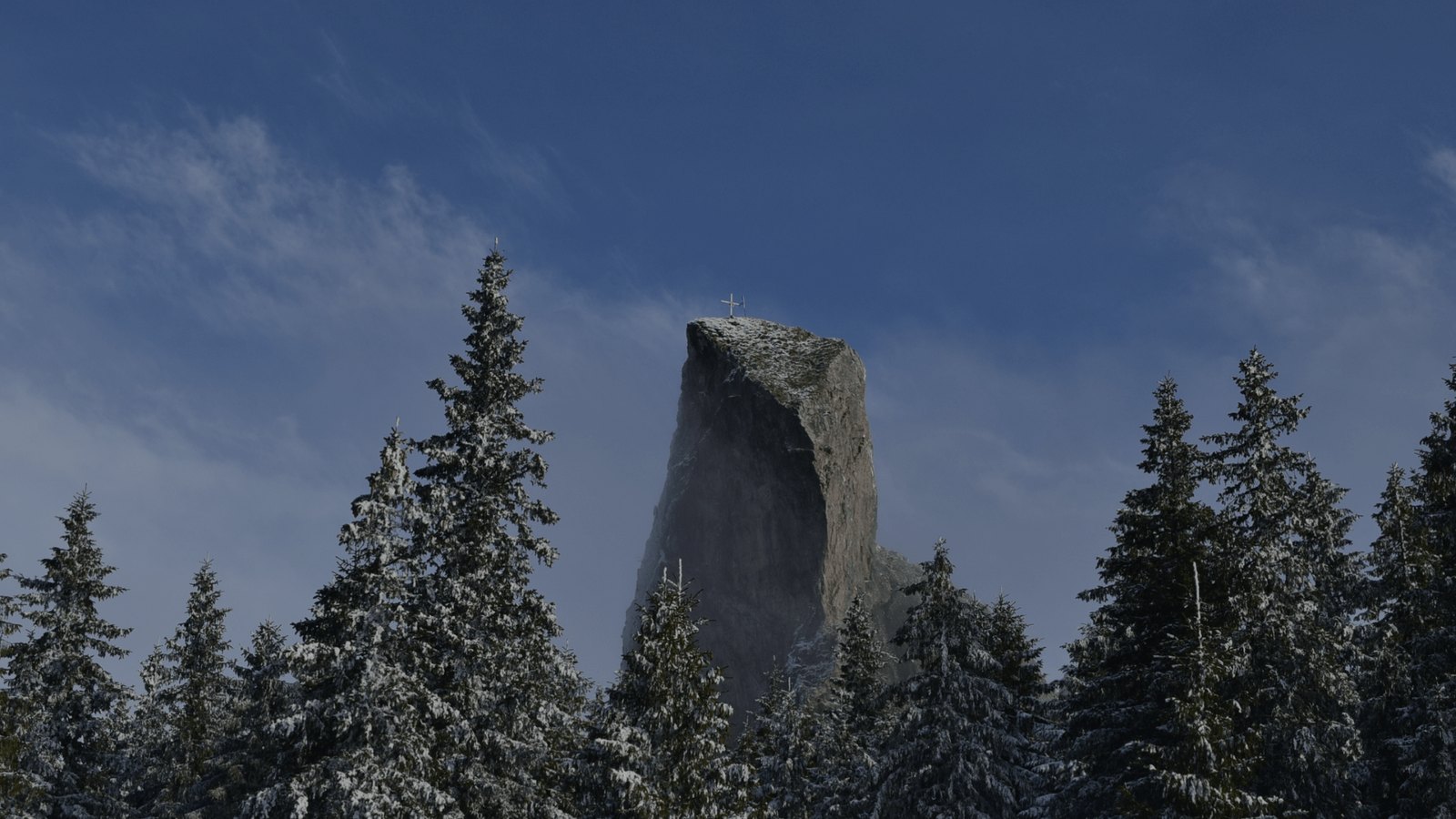
Since July 2025 Piatra Șoimului (1,577 m) has had Romania's first skywalk: a platform with a toughened-glass floor, shaped like a falcon's nest, hanging 600 m above the valley. Maximum 12–15 people on it; the panoramic binoculars are free.
- 3
The Pietrele Doamnei stand at 1,634 m and are reef limestone: the corals of a warm sea 140 million years ago, raised to the sky. Legend has it that Petru Rareș's wife hid her treasure here, and the mountain's name comes from Rareș.
- 4
Geo Bogza wrote that Rarău "here represents the fundamental dimension of the world". Up there, with Bucovina at your feet, you understand him.
- 5
From the Bodea crest you see, in a single turn, Valea Seacă, Runc, Măgura Runcului, the Pietrele Doamnei and Piatra Șoimului. It's the trail Câmpulung people do on Sundays, to see their town from above.
- 6
The Adam and Eva rocks, two dolomite knolls at the entrance to Fundu Pojorâtei, are, legend says, two lovers turned to stone. Geologically they are the remains of a reef, like the Pietrele Doamnei.
- 7
Giumalău stands at 1,857 m and is the highest peak around; from the top, on a clear day, you count six ranges: Rarău, the Obcini, Rodna, Călimani, Bistrița, Ceahlău. The subalpine meadow on the ridge is thick with blueberries in August.
- 8
The Zugreni gorge, at the foot of the trail, is the narrowest section of the Bistrița: walls over 200 m high, with the road and the river squeezed between them. Rafters stopped at the hut for hundreds of years, until the 1960s.
- 9
The Rarău hermitage (Sihăstria) has ties to the time of Petru Rareș and was moved to its present site at the end of the 18th century. It stands at almost 1,400 m among the spruces, with an icon that draws people from all over Moldavia.
- 10
Here the bell rings against the forest. Enter in silence, leave in silence; this is no place for flash photos.
- 11
The Slătioara old-growth forest has been a reserve since 1941 and, since 2017, a UNESCO World Heritage site (in the primeval beech forest category, although the star is the spruce). 1,064 ha, between 790 and 1,353 m, on three parallel ridges: Bâtca Neagră, Bâtca cu Plai, Bâtca Leșei.
- 12
Spruces and firs 300–500 years old, with trunks over 1 m across and 50 m tall; locals call it “Rarău's wooden cathedral”. Fallen trees stay where they fall: people don't intervene.
- 13
Edelweiss and lady's slipper, a protected orchid, grow on the crags. You photograph them, you don't pick them. And yes, there are bears, lynx and capercaillie; you rarely see them, but they see you.
- 14
The Popii Rarăului (1,628 m) are limestone towers lined up along the ridge like priests at a service, hence the name. You see them best from Șaua Ciobanilor, in morning light.
- 15
The Moara Dracului Gorge is a geological reserve: a corridor 60–70 m long and only 4–5 m wide between dolomite walls up to 70 m high. The name comes from the mill (moara) that supposedly ran here on its own, with water and “help” from the devil.
- 16
In summer it's a few degrees cooler between the walls than outside: the cold air stays trapped below. Bring something for your shoulders even in August.
- 17
Dealul Negru has had a chairlift since 1980, 3 km long, climbing to 1,300 m in about 25 minutes. If you want to shorten the descent or get the children up, it's an option: 50 lei return, last ride up at 4 pm.
- 18
Rusca is the village where the Bistrița starts to narrow towards the gorge; the forest road you climb was a logging road, today it's good for bikes too.
- 19
Cabana Giumalău sits at 1,600 m, has power from a generator and a wind turbine, but serves no meals: here you carry the food up yourself.
- 20
Valea Putnei is a village of old rafters and railwaymen; the small station you start from is on the Suceava–Vatra Dornei line, so you can arrive by train and leave from another station.
- 21
Chilii Peak, at 1,652 m, is the “station” on the ridge between Pojorâta and Giumalău. Sheepfolds settle on the meadow below it in summer; the dogs bark, the shepherds greet you, cheese can be bought.
- 22
Mestecăniș Pass (1,096 m) is the gap through which the Tatars entered Moldavia; the ridge track is still called the “Tatars' Road”. The crest towards Giumalău is one of the longest ridge walks in Bucovina, with no village on the way.
- 23
The Giumalău–Valea Putnei old-growth forest, which you climb through, is specially protected for the capercaillie. Walk quietly in the morning and you have a chance of hearing it.
- 24
Next to them, Piatra Zimbrului: a vertical limestone wall 600 m long and 100 m high, which climbers ascend on climbing routes. Did you know that the bison (zimbri), the animals that gave it its name, disappeared from Bucovina's forests in the 18th century? The rock remembers them.
- 25
The Bats' Cave, 1 km from the rocks, is the largest “gravitational” cave in Romania, but it's closed to visitors: the limestone blocks are unstable. You admire it from the path.
 Via Transilvanica