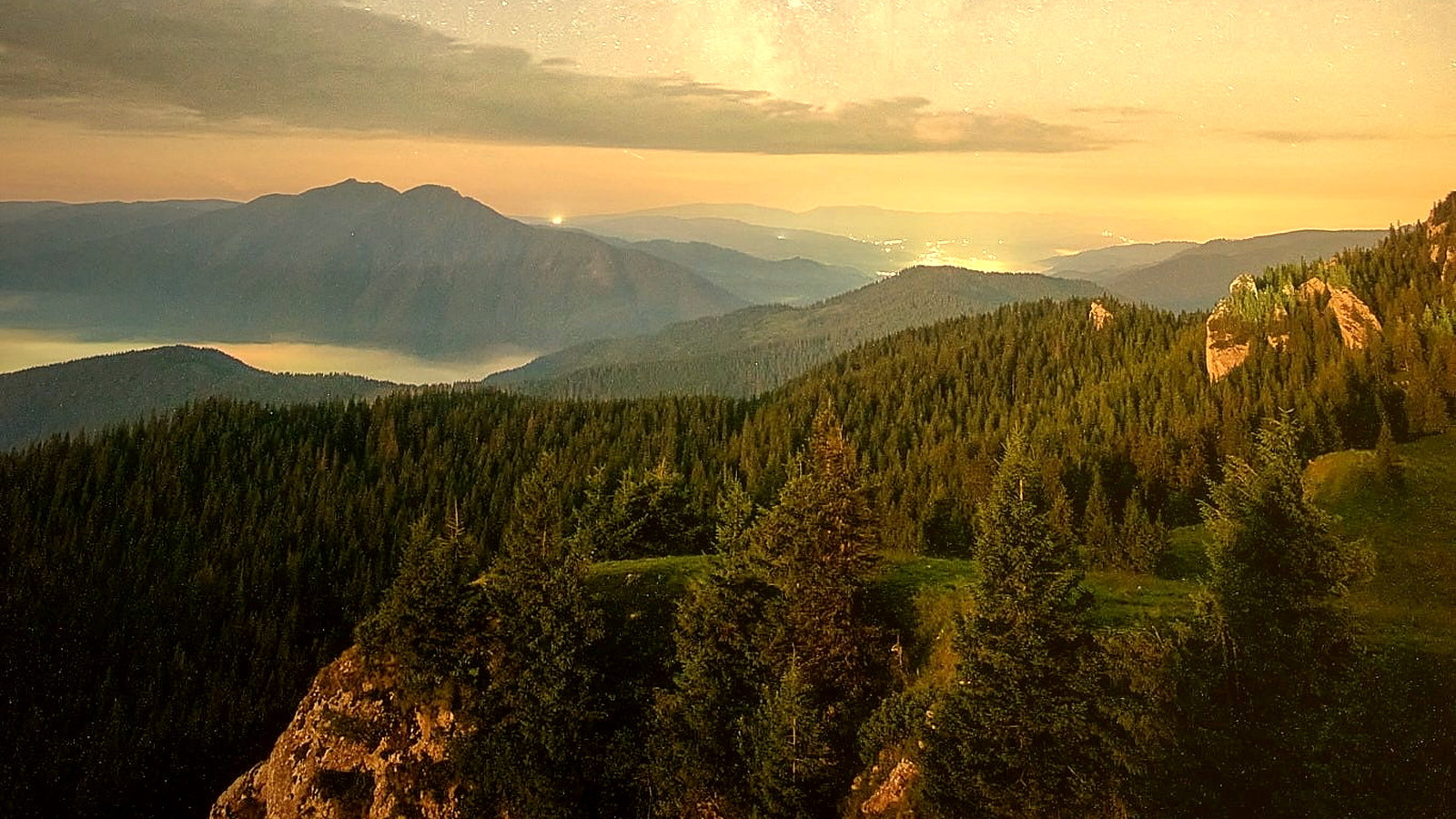
Valea Câmpulungului văzută de pe Rarău, în zori

The town beneath the Rarău

Câmpulung Moldovenesc

A long field between two mountains, which was a republic for four hundred years. What happened here, and how you get here.

The town has no citadel, no cathedral, and was never the capital of a country. It has something rarer: four centuries in which the people here obeyed no boyar. They governed themselves, elected their own judges, and paid for that freedom by guarding the passes into Transylvania.

Where
Suceava county, in Bukovina, northern Romania
On what
The river Moldova, between the Rarău massif and the Obcina Feredeului
Elevation
about 600 m
Coordinates
47°31′51″N, 25°33′05″E
Nearest large town
Suceava, 69 km to the east

The rest is geography. A ten-kilometre corridor of meadow on the river Moldova, with the Rarău to the south and the Obcina Feredeului to the north. Along it passed princes, Austrians, the railway and, in the end, the road that brings you.

Six hundred years, in seven stops

From the field with no name to the town of today. Tap an era and it opens.

before 1411

Before the records

A village older than the country

The settlement existed before Moldavia was a state. The name says everything about what the first person to arrive here saw: a long field, a tongue of meadow stretched between mountains, on the upper course of the Moldova. It was not built on a hill, as was done for fear of raids, but along the water, in a corridor that links Transylvania to the rest of Moldavia. That geography decided its fate for six hundred years.

1411

First time in writing

14 April, the deed of Alexandru cel Bun

It appears in a charter by which Moldovița Monastery receives the village of Vama, described as being „below Câmpulung”. So Câmpulung was already there, known well enough to serve as a landmark for someone else. The first mention of a place is often like that: not about it, but about its neighbour.

1411 – 1775

The peasant republic

The Ocol of Câmpulung: 15 villages, its own laws

The thing that makes the town truly singular. For almost four centuries, Câmpulung and the villages around it were a community of free people who obeyed no boyar. They governed themselves, through reeves, headmen and elders chosen from among the villagers, and judged their own disputes. Dimitrie Cantemir wrote in 1716, in „Descriptio Moldaviae”, that the people here „make up a kind of republic”. Eminescu would later name the thing outright: a peasant republic. The privileges were no charity: the Ocol was a fortress of the road, guarding the passes towards Transylvania, and the princes renewed them for that service.

1541

Petru Rareș crosses the mountain

and leaves a wooden monastery behind

The chronicler Grigore Ureche writes that the prince, returning from Transylvania, „crossing the mountain came out at Câmpul Lung”. That same year he raises, in the Hermitage Clearing at the foot of the Rarău, a wooden monastery. Later, after Bukovina was annexed, it is moved across the massif, towards Chiril, where it stands to this day: it is Sihăstria Rarăului, the closest of them all to us.

1775 – 1918

The Austrians

The end of autonomy, the beginning of the town

On 7 May 1775, by a Turkish-Austrian convention, Bukovina passes to the Habsburgs. Military administration follows until 1786, then attachment to Galicia, and from 1848 the status of an autonomous duchy. The peasant republic dies out, but the town and its institutions appear: in 1794 Vienna grants it the rank of market town, in 1866 the rank of town, and after 1867 it becomes a district capital, one of the nine in Bukovina. The railway comes then too, the one that brings you here today.

1918 – 1950

County capital

Câmpulung, without a surname

After the Union, Bukovina is divided into five counties, and Câmpulung is the capital of one of them. Until 1950 it is called simply Câmpulung, without „Moldovenesc”. The addition comes so it is not confused with the Câmpulung in Argeș, and since then the town carries a double name that also tells you its region.

1950 – today

The town beneath the Rarău

15,642 people, 600 metres above the sea

The county disappears in the 1950 reform, and the town remains what it is today: a mountain town stretched over ten kilometres along the water, with the Rarău on one side and the Obcina Feredeului on the other. In 1995 it becomes a municipality. It never truly industrialised, and that is its luck: you can hear the river, and wood is still worked here.

What makes it unique

Six things you won't find elsewhere, or not in this form.

It was a republic for four centuries

In a Europe of serfs, the people here were free, chose their own leaders and judged their own disputes. Cantemir wrote about it in 1716 as an oddity of Moldavia. It was no oddity, it was a bargain: autonomy in exchange for guarding the passes.

The name is a description, not a name

„Câmpulung” does not come from a prince, a saint or a boyar. It comes from what could be seen: a long field. The town was built to the shape of the valley, not the other way round, and that is why it is still one of the most spread-out in the country for the number of people in it.

It has a museum of wood

One of the few in Europe devoted solely to wood: tools, household objects, joinery techniques without nails. In a land where the house, the church, the spoon and the toy were made of the same material, this museum is not a curiosity, it is an autobiography.

The 1541 monastery moved across the mountain

Raised by Petru Rareș at the foot of the Rarău, it was moved after 1775 to the far side of the massif, to Chiril, to escape the new administration. Few buildings in Romania have crossed a mountain in order to stay what they were.

Two mountains, two worlds

The Rarău, 1,651 metres, with the Pietrele Doamnei rising out of the forest like limestone fangs. The Giumalău, 1,857, round, covered in spruce to the very top. You have both less than an hour from the centre, and the town runs between them.

Kilometre zero of a 1,400-kilometre road

The Via Transilvanica starts at Putna, but the stage that passes by us, Vatra Moldoviței – Sadova, is one of the finest of the whole trail. From its clearings you see the Rarău with the Pietrele Doamnei.

How to get to Câmpulung Moldovenesc

Four ways, with distances, timetables and fares taken from official sources, not from estimates.

By plane

Suceava is 82 km away. The rest are fallbacks.

  • „Ștefan cel Mare” Airport, Suceava (SCV) 82 km · about 1 h 20 min Strada Aeroportului 1, Salcea. Scheduled flights to Bucharest with TAROM, daily, and to eleven European cities with Wizz Air: London Luton, Rome Fiumicino, Milan Malpensa and Bergamo, Bologna, Venice Treviso, Birmingham, Brussels Charleroi, Dortmund, Memmingen and Karlsruhe.
  • Line 8, to the railway and coach stations since 31 March 2025 The bus linking the airport with Suceava's railway and coach stations. The timetable is on the airport's site, aeroportsuceava.ro, under „Transfer Aeroport”.
  • Airport parking 240 spaces · season ticket 24 lei/day The season rate applies if you leave the car between 6 and 15 days. Under six days you pay the normal tariff.
  • Iași (IAS) 200 km · about 3 h The largest airport in Moldavia, with more international routes. Worth it if you find no connection to Suceava.
  • Bacău (BCU) and Cluj (CLJ) 180 km · about 3 h / 280 km · about 4 h 30 min Fallbacks, with a long but beautiful drive through the mountains.

The flight schedule above is the one valid between 29 March and 24 October 2026, published by the airport. It changes in winter. Information: office@aeroportsuceava.ro, 0230 529 999, Monday to Friday, 7:30–15:30.

By car

The DN17, the road that links Bukovina to Transylvania

  • From Suceava 69 km · about 1 h 20 min On the DN17, westwards, through Gura Humorului. A European road, cleared of snow in winter.
  • From the airport, Salcea 82 km · about 1 h 20 min You skirt Suceava on the bypass and join the DN17.
  • From Iași 200 km · about 3 h Through Suceava, then the DN17.
  • From Bucharest 450 km · about 7 h Through Bacău and Vatra Dornei, or through Suceava.
  • From Cluj-Napoca 280 km · about 4 h 30 min Over the Tihuța pass, still on the DN17.

Winter tyres are compulsory on roads covered with snow or ice. The DN17 is cleared constantly, but the roads to the villages are cleared later.

By train

Five trains a day from Suceava

  • Suceava – Câmpulung Moldovenesc about 1 h 30 min Five pairs of trains a day, on the Suceava – Vatra Dornei – Cluj main line. Operator: CFR Călători.
  • Two stations in town Câmpulung Moldovenesc and Câmpulung Est The first is the central one. Check on your ticket which one your train stops at: there are a few kilometres between them.
  • From Bucharest about 8 h With a change at Suceava, or direct on the Cluj – Galați route, which passes through Câmpulung.
  • Timetable and tickets mersultrenurilor.infofer.ro · cfrcalatori.ro Bought online right up to departure. Timetables change twice a year, in December and in June.

The train is the finest way into Bukovina. The line climbs the Moldova valley, and the last half hour is worth spending at the window.

By coach

Fewer services, but direct

  • Suceava – Câmpulung about 1 h 40 min Direct services, a few times a day, from the Suceava coach station. Timetables and tickets on autogari.ro.
  • Towards Vatra Dornei and Transylvania on the DN17 The through minibuses stop in Câmpulung as well.
  • In town the Pod Sadova – Podul Bucătarului line Local public transport runs on a single line, along the length of the town. The timetable is on campulungmoldovenesc.ro.

Timetables change often and are not centralised anywhere. If you come by coach, check autogari.ro the day before.

Where to rent a car

Without a car you see the town. With a car you see Bukovina. There are no rental firms in Câmpulung, so the car is picked up in Suceava and driven here.

SCV Terminal, Salcea

Straight from the airport

The desks are in front of the arrivals terminal. Enterprise has an office there, and the airport publishes the full list of firms on its site, under „Rent a car”.

You take the car on landing and leave it on departure, with no extra journey.

You need a valid licence, issued at least 12 months ago, an identity document and a card in the driver's name. For licences from outside the EU an international permit is also required.

offices in town

From the city of Suceava

Several firms have offices in Suceava, not only at the airport. Some will bring the car to the railway station free of charge. It is the logical choice if you arrive by train.

Fares are usually lower than at the airport.

The town offices work daytime hours. If you arrive in the evening, there is nowhere to collect the car.

The details on flights, parking and the transfer to the station are those published by „Ștefan cel Mare” International Airport Suceava, and those on trains by CFR Călători, checked in September 2026. We have no arrangement with any rental firm and recommend no one in particular: fares and fleets change from one season to the next, so it is worth comparing before you book.

Book direct

Same nest, better price.

No platform commission. Self check-in, late check-out when possible and free cancellation up to seven days before.

799 lei a night on Booking 599 lei / night Book