The monasteries of Bucovina · Mitocu Dragomirnei, Suceava County
1602–1609 · Metropolitan Anastasie Crimca
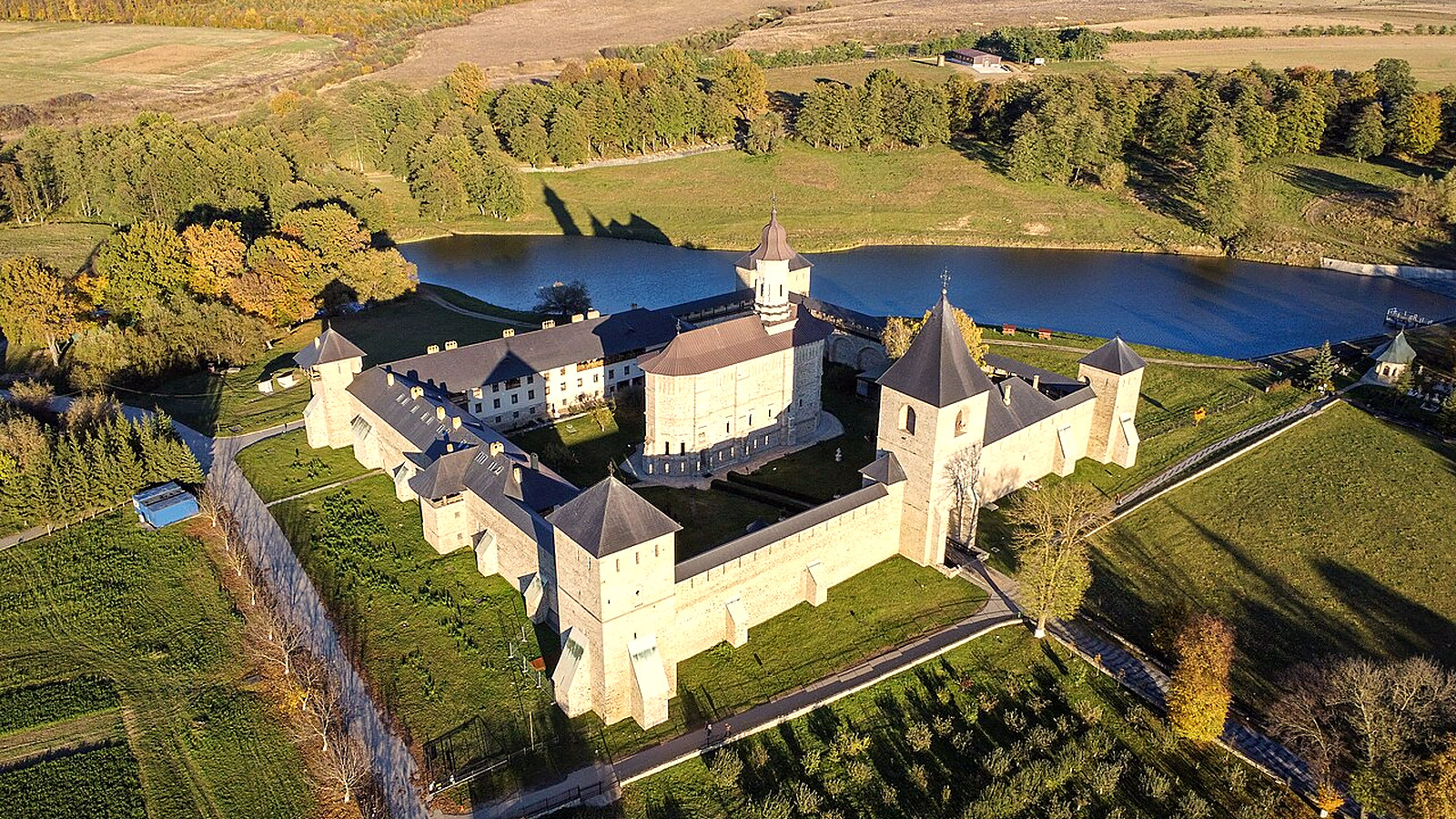
A silhouette without equal: forty-two metres high on nine wide, a church as slender as a candle of stone. Around the tower, a carved band twists like a rope. It is the tallest medieval church in Moldavia, and it shows from far off, across the lake.
If you only have a minute
The tallest medieval church in Moldavia, and the most unusual: 42 metres high on a width of only 9.6, a proportion without equal in Romanian architecture. The enclosure walls, raised by Miron Barnovschi, are up to three metres thick.
What you find only here
Forty-two metres high on nine point six wide: a ratio of one to four and a half, which is not repeated in any other medieval Romanian church. Close up it looks like a candle of stone. Around the tower, a carved band twists like a rope, and the decoration mixes Gothic and Renaissance motifs in a way that appears nowhere else in Moldavia.
Open daily. The museum keeps Crimca's illuminated manuscripts.
The proportion of 42 metres high on 9.6 wide has no equal. The tower is ringed by a stone band twisted like a rope, and the carved decoration mixes Gothic and Renaissance motifs.
You arrive in the courtyard and look around without knowing where. These are 4 places on the walls that people who know look for.
Forty-two metres high on nine point six wide. No other medieval Romanian church has this silhouette.
A carved torus that rings the tower like a rope. Symbolic explanations circulate, but no contemporary document confirms them.
The founding metropolitan was also a miniaturist. The manuscripts made by him and his school are among the most valuable in Moldavian art.
Three metres thick in places, with a sentry walk. The monastery was designed to withstand a siege.
Things that are less widely known, and that nobody tells you at the gate.
42 metres high, 9.6 wide. No other medieval Romanian church has this silhouette.
A carved torus rings the tower like a rope. It is said to symbolise Moldavia bound to its faith, but no contemporary source confirms it.
The founding metropolitan was also a miniaturist: the manuscripts made by him and his school are among the most valuable in Moldavian art.
The monastery was plundered in 1653 by the army of Timuș Khmelnytsky, son-in-law of Vasile Lupu, and the monks were forced to abandon it for years.
If you only have 30 minutes: The church from the outside, for the proportion, and the band on the tower.
The lake in front and the forest behind.
The best pairing with Suceava.
The beech forest around changes colour.
Open.
the citadel and the museums
the oldest surviving foundation of Stephen
Suggested circuit: Dragomirna → Pătrăuți → Suceava, a well-joined day.
Yes, between 15 April and 15 October. The guest house has rooms with two and with eight beds, for pilgrims and for travellers.
Yes. The monastery announces on its own site that travellers may take a meal.
Mitocu Dragomirnei, jud. Suceava · 90 km from Câmpulung Moldovenesc
Further on
Hours and fees change from one season to the next, and we could not confirm them from an official source.
Book direct
No platform fee, because there is nobody in between. You let yourselves in with a code, you leave late if nobody is coming after you, and if plans change you cancel free up to seven days ahead.
 Via Transilvanica