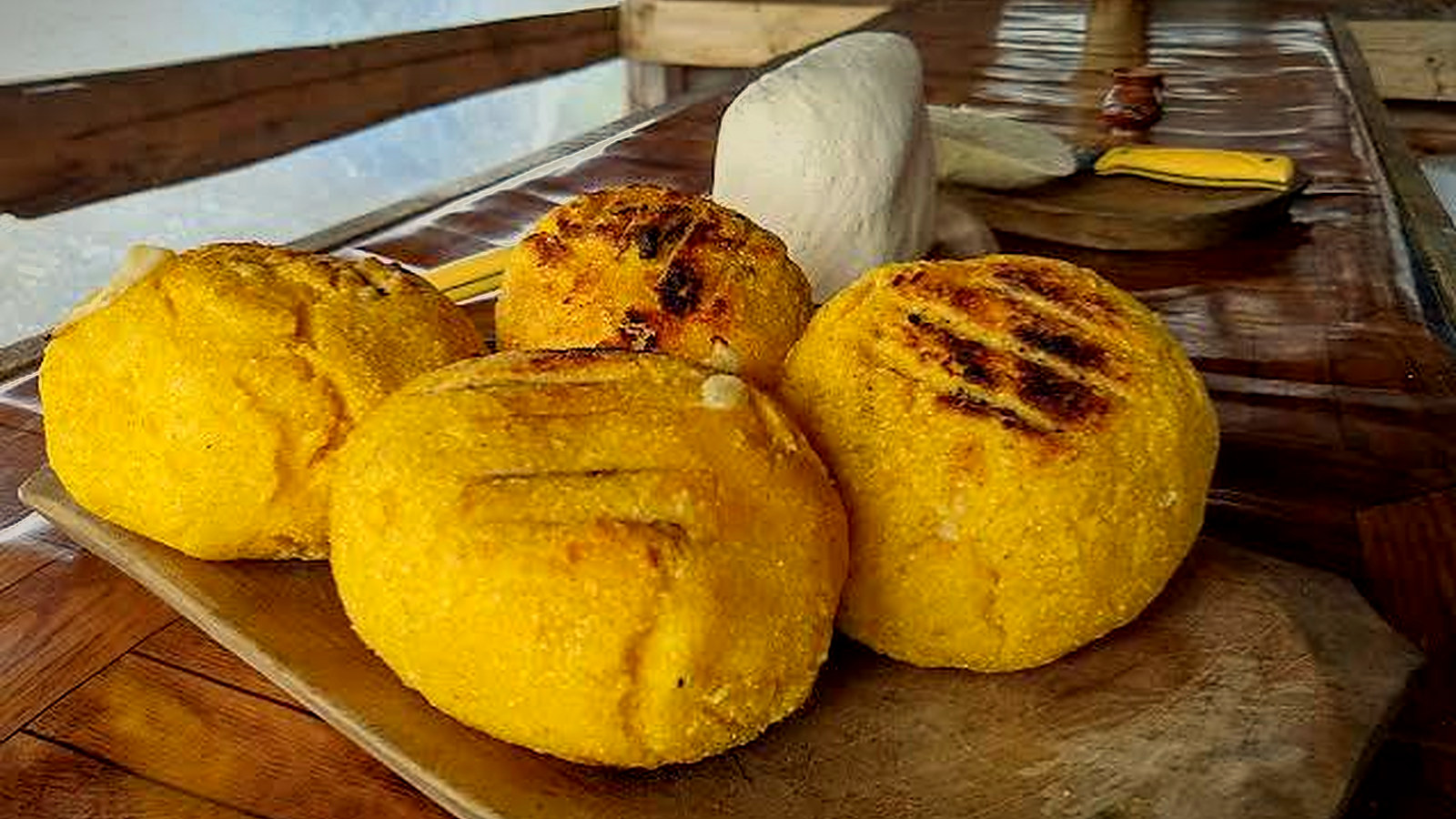
Bulgări de mămăligă rumeniți pe grătar, pe un fund de lemn, la stână

Shepherds' folds · Bucovina

The shepherds' fold in Bucovina: what they eat up there

Caș, urdă, balmoș and jintiță, how they come into being in front of you, and the folds that take visitors.

At a sheepfold you don't order food. It is made in front of you, in the order in which milk comes apart: first the caș, then the urdă from the whey that is left, and last the jintiță, which the shepherds drink warm. Nothing that reaches the table was, two hours ago, anything other than milk.

This is not a restaurant with rustic decor. It is a hut with a hearth that burns day and night, fir shelves above it, and the smell of smoke travels home with you, in everything you have on your shoulders.

Shepherds' folds you can visit

Eight folds and places that take visitors, with phone number and season. Distances are from our gate, in Câmpulung Moldovenesc.

seasonal 50km

Telescaun Tourist Fold

Vatra Dornei, Suceava County

You get there by chairlift from town, with no car and no hiking. It is the simplest way into the world of the fold, good if you have small children or little time.

What you eat

  • warm balmoș
  • platters of traditional dishes
  • natural forest-fruit juices, in summer
Season
May – September
Booking
recommended
Drive
about 55 min by car
all year 58km

Măgura Tourist Fold

Str. Valea Pintei, Dorna Candreni, Suceava county

One of the few open in winter too. You won't see milking in December, but you see the hut, the hearth and how life is lived up there out of season.

The menu

Agreed when you book. You call and ask what there is that day: at a fold they cook from whatever the milk gave that morning.

Season
all year
Booking
compulsory
Drive
about 65 min by car
seasonal 78km

Sesie, Subvăcărie, Borcutu and Șfețărie folds

Ciocănești, Suceava County

Four folds run by the „Suhardul” livestock breeders' association of Ciocănești. The second number is the information centre in Ciocănești, where they know which of them is up on the mountain and taking visitors that day.

The menu

Agreed when you book. You call and ask what there is that day: at a fold they cook from whatever the milk gave that morning.

Season
May – September, and out of season on request
Booking
compulsory
Drive
about 85 min by car
seasonal 78km

Arseniuc Tourist Fold

Ciocănești, Suceava County

Here you can stand beside the shepherds at the milking and follow the cheese from the first drop of milk to the last piece, and at the end you eat balmoș and urdă. The visit is arranged through the guesthouses in Ciocănești.

What you eat

  • balmoș
  • urdă
  • cheese made in front of you
Season
May – September, for as long as the sheep are on the mountain
Booking
compulsory
Drive
about 85 min by car
all year 58km

Casa Răzeșului

Șaru Dornei, Suceava County

A shepherd's meal to order, in the heart of the Călimani. It goes well with a day in the national park.

The menu

Agreed when you book. You call and ask what there is that day: at a fold they cook from whatever the milk gave that morning.

Season
all year
Booking
compulsory
Drive
about 70 min by car
all year 78km

Bâtca Tisei Guesthouse

Ciocănești, Suceava County

The version with a roof over your head: the same dishes, served at the guesthouse, for anyone who doesn't want to climb to the fold.

The menu

Agreed when you book. You call and ask what there is that day: at a fold they cook from whatever the milk gave that morning.

Season
all year
Booking
compulsory
Drive
about 85 min by car
all year 66km

Poiana Guesthouse

Poiana Negrii, Dorna Candrenilor, Suceava county

On the Via Transilvanica, at the end of the Vatra Dornei – Poiana Negri stage. If you are walking the trail, this is the meal waiting for you in the evening.

The menu

Agreed when you book. You call and ask what there is that day: at a fold they cook from whatever the milk gave that morning.

Season
all year
Booking
compulsory
Drive
about 75 min by car
all year 14km

La Stâna Bucovineană

Sadova, Suceava County

Not a fold on the mountain but a village dairy, working milk brought down from the pastures of Sadova and Pojorâta. Here you buy rather than watch: caș, telemea, butter, sour cream, yoghurt. It is the closest one to us.

What you eat

  • matured caș „Senectute”
  • cow's telemea, plain, with caraway or with chilli
  • goat's telemea and sweet caș
  • fresh cheese
  • sour cream
  • unt
  • cow's and goat's yoghurt
  • soured milk
Season
all year
Booking
compulsory
Drive
about 18 min by car

The phone numbers and seasons above are those published by the Țara Dornelor Ecotourism Association and by the hosts themselves, checked in September 2026. „May – September” is the range they announce; the exact date the sheep go up and come down changes every year, with the snowmelt, so call before you set off. Distances are estimated by road from our gate.

What you eat at a shepherds' fold, and how it is born

Eight things, in the order they emerge from the same cauldron of milk.

Caș

the first thing milk gives up

30 minutes after milking

The milk, just drawn and still quick with the animal's warmth, takes rennet and is left in peace. Within half an hour it parts into two worlds: one white and dense, which gathers itself, and one greenish, which stays above. The shepherd sinks his hands into the cauldron, lifts the curd like dough, gathers it in a cloth and hangs it to drain. What is left in his palms is caș: sweet, unsalted, tasting of grass and smoke.

Eaten that same day, cut thick, with warm polenta.

Urdă

the second life of the whey

an hour after the caș

The whey left after the caș looks like water to throw away. The shepherd puts it back on the fire and brings it close to the boil. Then, on the surface, a white and delicate cloud rises that a moment before was not there. It is lifted with a spoon, settled into a cloth and left to drain. Urdă is everything the milk still kept for itself after it had given the caș: sweet, light, almost sugary.

Plain, with dill, or mixed with sour cream over polenta.

Balmoș

polenta boiled in cream, not in water

40 minutes over the cauldron

No water goes in. Thick sour cream goes into the cauldron and is left to come to the boil until the butter starts to rise. Only then is the maize flour scattered in, by hand, in a thin rain, stirred always the same way. The mixture thickens and turns golden, and towards the end pieces of caș are broken into it and melt into threads. Balmoș is polenta taken to its furthest point: rich, heavy, made by shepherds.

Eaten straight from the cauldron, scalding hot, with a wooden spoon.

Jintiță

what stays in the cauldron after the urdă

as long as the urdă takes

Once the urdă has risen and been lifted off, a yellowish liquid stays in the cauldron, with eyes of fat at the surface. That is jintiță. The shepherds drink it warm, straight from the cup, because it is the last thing the milk has to give. It tastes of melted cheese and smoke, it is slightly sour, and it takes the unaccustomed by surprise.

Drunk warm, on the day it is made. By the next day it is gone.

Kneaded cheese

the caș that had time to settle

from two days to two weeks

Caș left to mature for a few days turns crumbly and sharper in taste. It is then broken into pieces, salted and kneaded by hand until it becomes one mass again. It is pressed into a fir bark vessel or a wooden tub and left in the cold. The kneading is not a formality: it breaks the structure and lets the salt reach everywhere, and the cheese takes on that sharpness that caș does not have.

It keeps for months. With onion and dark bread.

Sheepfold butter

cream beaten until it breaks

20 minutes of churning

The cream goes into the churn and is beaten with the plunger, up and down, for minutes on end. At first nothing happens. Then, suddenly, the emulsion gives way: the fat gathers into yellow grains and the rest turns to buttermilk, thin and slightly sour. The grains are gathered, washed in cold water and worked by hand until all the water is out. Sheepfold butter is yellow, not white, because the cow ate grass, not feed.

On warm polenta, where it melts before it reaches your mouth.

Polenta over the fire

over flame, not over a hob ring

25 minutes

The cast-iron cauldron hangs over an open fire, not on a hotplate. The water boils unevenly and the maize flour goes in like rain, with salt, stirred with the wooden stick until not a single lump is left. The difference is made by the bottom of the cauldron, which gets hotter than any pan could: that is where the golden crust forms, the one the shepherds break off at the end and eat on its own.

Turned out onto the wooden board and cut with thread, never with a knife.

Smoked caș

fir smoke, four days

three or four days above the hearth

The drained caș is set on shelves, high up in the hut, directly above the hearth that burns day and night. Fir smoke rises slowly and wraps around it. In three or four days the rind turns orange and hard, while the inside stays soft. The smoke is not only flavour: it dries the surface and seals it, and the cheese survives on the mountain all season, with no fridge.

Sliced thin, like cured meat. It travels in a rucksack without spoiling.

What to know before you climb to the fold

Book direct

Same nest, better price.

No platform commission. Self check-in, late check-out when possible and free cancellation up to seven days before.

799 lei a night on Booking 599 lei / night Book