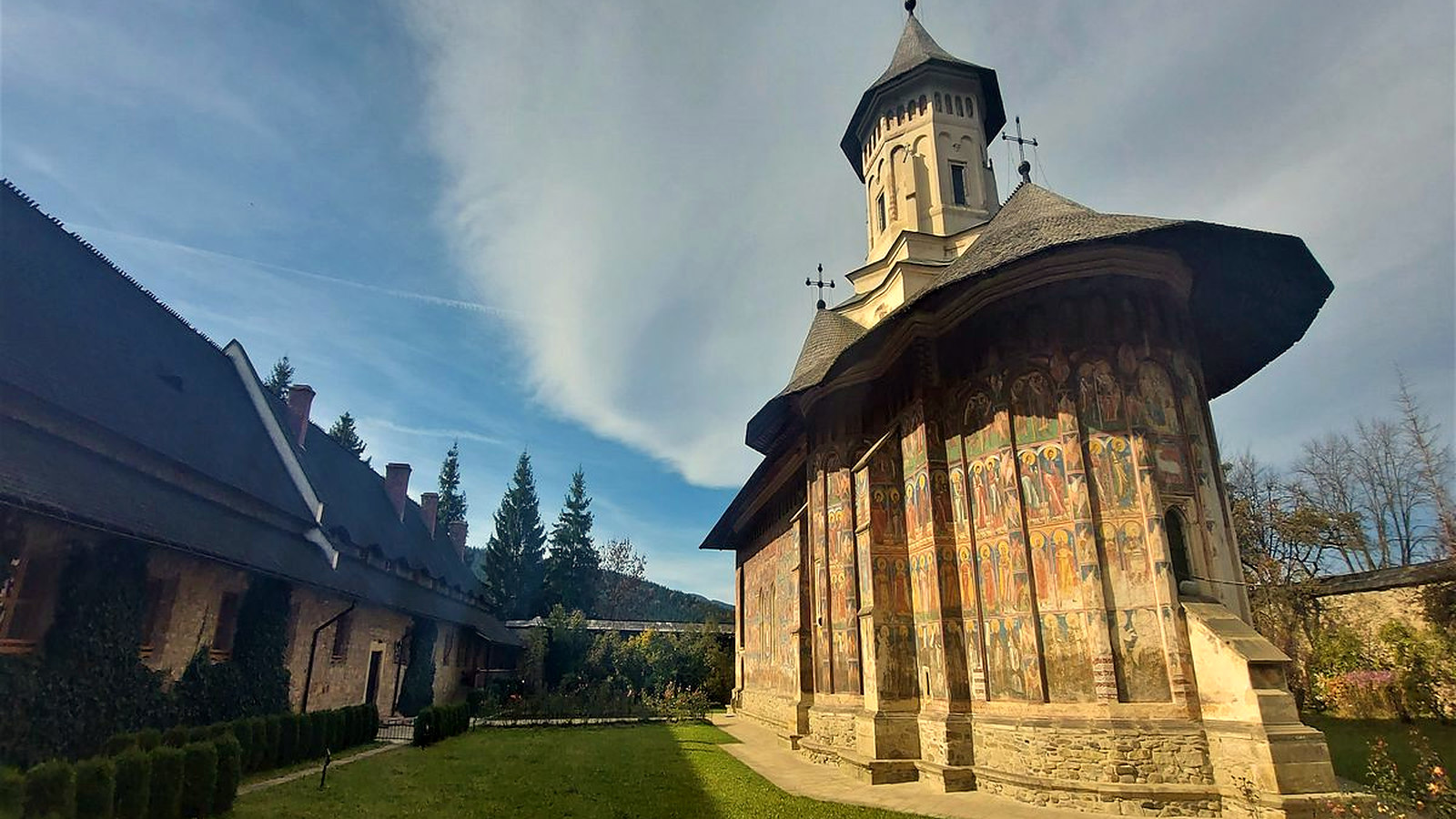
The monasteries of Bucovina · Vatra Moldoviței, Suceava County
1532 · Petru Rareș · UNESCO monument
A political fresco disguised as a religious scene: the Siege of Constantinople, with Turks firing cannon that Byzantium had never known. The painter was speaking about the threat of his own time, not about 1453. It is also the painted monastery closest to our house.
If you only have a minute
Built by Petru Rareș on the site of an older monastery brought down by a landslide. The south wall carries the Siege of Constantinople, a political fresco disguised as a religious scene: the besieging Turks are painted with cannon Byzantium had never known, because the image spoke about the Ottoman threat of the painter's own day.
What you find only here
On the south wall is painted the Siege of Constantinople, which fell in 1453. Except that the Turks in the fresco fire cannon, a weapon the Byzantium of the image had never known. It is not the painter's mistake: it is his message. The scene spoke about the Ottoman threat of the 1530s, when it was painted, using the fall of the city as an allegory. It is one of the few moments in medieval art when a painter deliberately falsifies the period, so as to be understood by his contemporaries.
Open daily. The museum keeps Petru Rareș's throne.
A triconch plan with an open porch, five great arcades across the west facade. That opening is Rareș's innovation: it lets the light fall straight onto the painting at the entrance.
You arrive in the courtyard and look around without knowing where. These are 5 places on the walls that people who know look for.
The Turks are painted with sixteenth-century artillery, although the city fell in 1453. The fresco spoke about the Ottoman danger of the painter's own day.
The genealogy of Christ, with ancient philosophers at the base, Plato and Aristotle among them.
The wooden princely chair, one of the few pieces of princely furniture left from the period.
The first foundation, destroyed by a landslide, which forced the move down into the valley.
The enclosure is fortified, with a bell tower and walls, as at Sucevița, but on a smaller scale.
Things that are less widely known, and that nobody tells you at the gate.
The city fell in 1453, but the painter added sixteenth-century artillery: the fresco spoke about the Ottoman danger of his own time, not about the past.
Petru Rareș's wooden chair is kept in the monastery museum, one of the few pieces of princely furniture left from the period.
The genealogy of Christ climbs from the ground up under the eaves, with ancient philosophers painted at its base, Plato and Aristotle among them.
The first foundation, from the end of the fourteenth century, was destroyed by a landslide. Its ruins can be seen a few hundred metres away.
the DN17 west, then the DN17A to Vatra Moldoviței
the DN17 to Gura Humorului, then the DN17A
the DN17 east
If you only have 30 minutes: The south wall, with the Siege and the Tree of Jesse. The museum, only for the throne.
The Moldovița valley opens early; almost total quiet.
It goes well with the Moldovița narrow-gauge train, which runs in season.
The best light on the south wall.
Open, very quiet.
a narrow-gauge train, on the line of 1888
the Palma monument, towards Sucevița
over 11,000 exhibits
Suggested circuit: Moldovița → the narrow-gauge train → the Ciumârna pass → Sucevița, a full day, without hurrying.
Yes, but limited, in the guest house, for pilgrims. For an ordinary room, look in Vatra Moldoviței or in Câmpulung.
Vatra Moldoviței, jud. Suceava · 35 km from Câmpulung Moldovenesc
Further on
Hours and fees change from one season to the next, and we could not confirm them from an official source.
Book direct
No platform fee, because there is nobody in between. You let yourselves in with a code, you leave late if nobody is coming after you, and if plans change you cancel free up to seven days ahead.
 Via Transilvanica