 Via Transilvanica
Solonețu Nou
The oldest of the Highlander villages, and the place where once a year the whole of Polish Bukovina meets.
The oldest of the Highlander villages, and the place where once a year the whole of Polish Bukovina meets.
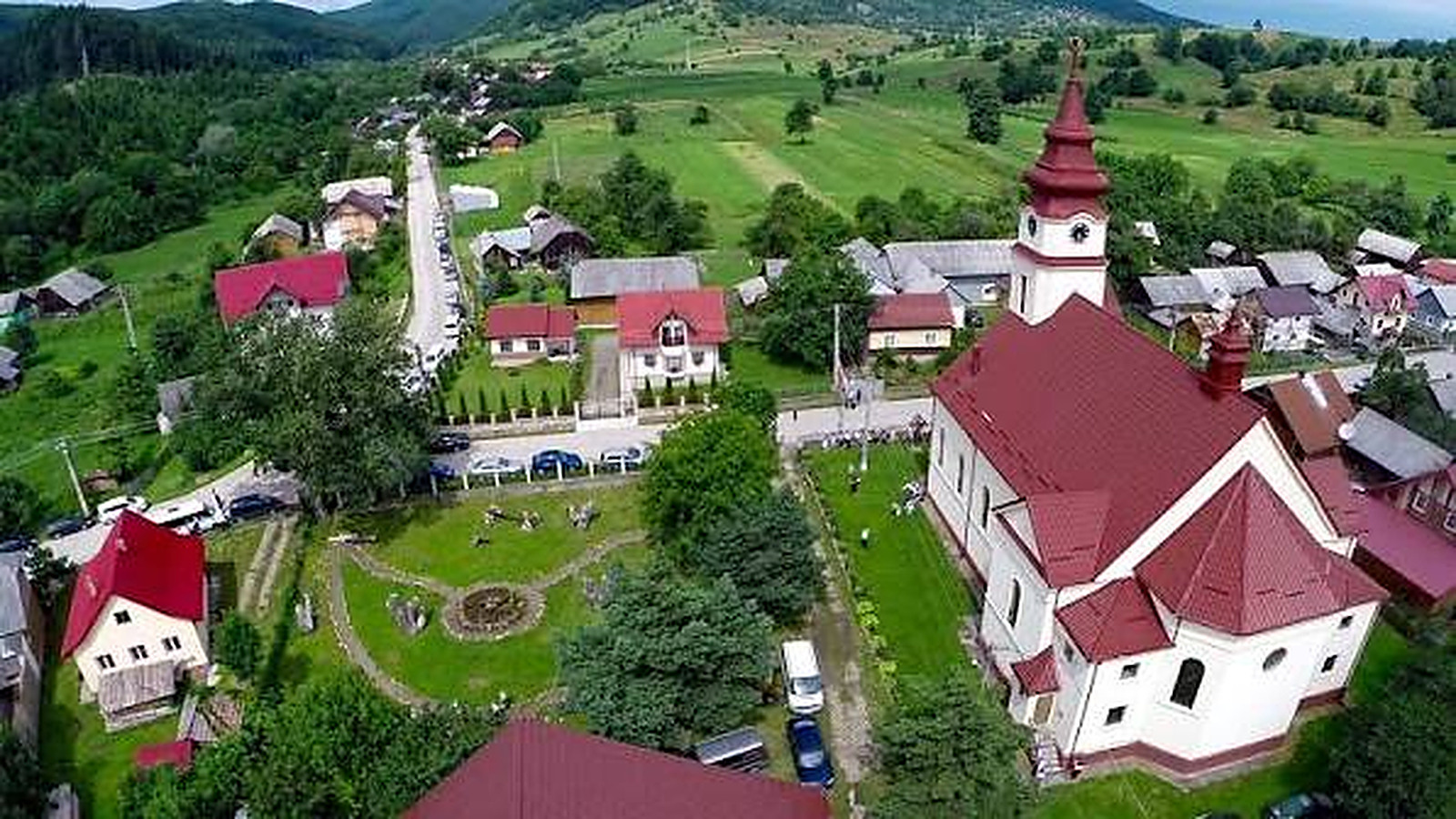
Solonețu Nou was the first of the three Highlander villages in southern Bukovina: in 1834 thirty families settled here from overcrowded Hliboca, their forebears having come from the Czadca country. They were given land in the Soloneț valley, mostly forest and pasture, and began by clearing it.
The village grew fast: 648 inhabitants in 1880, 725 in 1890, 871 in 1900. At the end of the 19th century some families left for Brazil, and from 1896 for Bosnia, together with Highlanders from Pleșa and Poiana Micului.
It is today the largest compactly Polish settlement in Romanian Bukovina. At the 2002 census Poles made up 89.7 percent of its inhabitants. There is the Henryk Sienkiewicz School: a Romanian school, taught in Romanian, but with Polish lessons for every pupil.
The village borders Ukrainian, Greek Catholic Maidan. Three languages within a few kilometres, with no history of conflict.
The solid concrete road to Solonețu Nou was built as part of Romania's debt repayment to Poland, during President Aleksander Kwaśniewski's first term. It is hard to find a more literal trace of the relations between two states than the tarmac you drive in on.
Since 2006 the village has hosted the Harvest Festival, the climax of the Days of Polish Culture. It opens with a mounted parade: horses dressed in ribbons, riders in Polish costume. Then the mass, the display of harvest and food from every Polish village, beside the Romanian and Ukrainian neighbours, and the concert of the ensembles.
If you are to come to Bukovina only once, come then. It is the one day of the year when all of Polish Bukovina is in one place.
Data gathered by Marian Gotkiewicz, a scholar of the history of the Czadca Highlanders.
Seat of the local branch of the Union of Poles in Romania and rehearsal place of the „Sołonczanka” ensemble. Part of the Harvest Festival happens here.
Mass is sometimes said in Polish. At the Harvest Festival the whole day starts here.
A Romanian primary school where every pupil learns Polish as a mother tongue.
The Polish Houses and the churches open for mass and for rehearsals, not for sightseeing. Write to us a few days ahead: we will help arrange a visit.
Czytaj dalej
Your base
Câmpulung Moldovenesc is an hour from the Polish villages and an hour from the painted monasteries. The whole house, seven beds, parking in the yard.