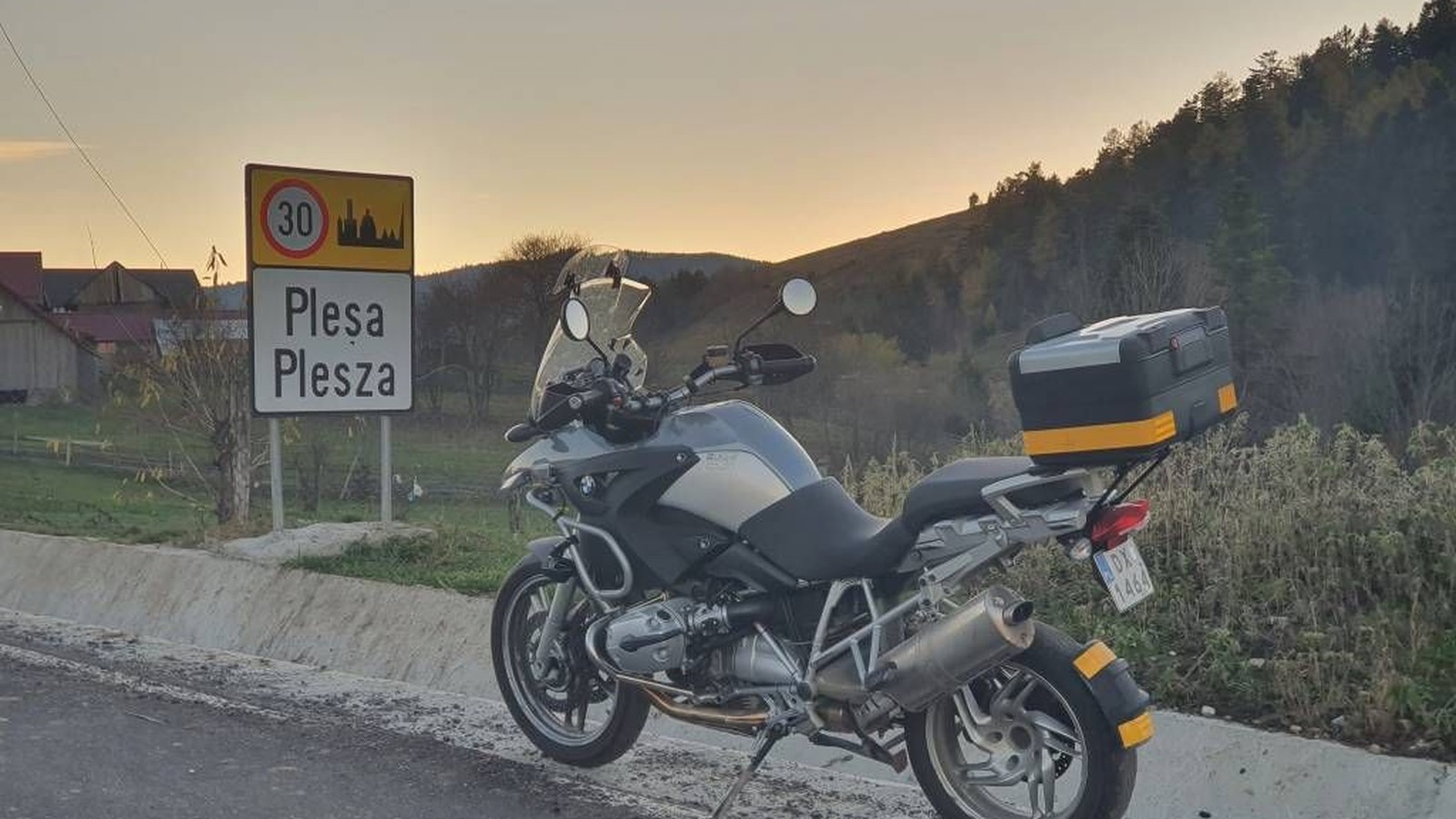
The village on the summit, while all the others lie in the valley. Nobody quite knows why.
The petition of 17 July 1835
In the spring of 1835 Highlanders from overcrowded Kaliczanka, near Cernăuți, set out to look for a place. They found an empty slope on the border of the Solca and Ilișești estates. On 17 July the representatives of sixteen families, led by Marian Zendek, lodged a petition with the Cernăuți district office for the southern slope of Mount Pleșa.
The petition was granted. The forester from Ilișești measured out 482 acres at between 650 and 730 metres, on both sides of the old mountain track. Houses began to go up in March 1836. So arose the second Polish Highlander village of southern Bukovina, and for a long time the only wholly Polish one.
Why up there, and not in the valley
This is the oddity everyone who comes here talks about. The villages around lie in valleys, by water and by the road. Pleșa lies on the summit, at 734 metres. Historians have no clear explanation; two legends circulate, but neither can be proved.
The people here have their own answer, simpler and better: the higher up, the closer to God.
They speak „the Pleșa way”
Linguists came to study the speech, expecting archaisms after two centuries of isolation. The result surprised them: the Polish of Pleșa hardly differs from today's. The people themselves insist anyway that they speak „the Pleșa way”, not Polish.
And a Polish teacher settled here for good only in 1906, later than in any other Polish village of Bukovina. The language, then, held on by itself, without a school, for seventy years.
The church that had to be rebuilt
On the summit stands the church of Saint Anne, consecrated in 1904. During the Second World War the villagers wandered through northern Bukovina; they returned in 1945 and found it wholly destroyed. On this hill German troops had held out against the Soviet army standing at Solca.
After the repatriates left for Poland, about fifty Polish families remained. They rebuilt the church and stayed.
Its own parish, after a hundred and seventy years
The church belonged in turn to the parish of Gura Humorului, from 1921 to Solonețu Nou, and from 2003 to Poiana Micului. A parish of its own was erected only in 2014. The first priest was Father Andrzej Staszkowian, himself a descendant of Bukovina Highlanders from neighbouring Solonețu Nou; he died in 2022. The parish books today list 153 faithful.
What is here today
One hundred and seventeen people, all of Polish descent and all Catholic. Polish is taught in the kindergarten and in grades one to four. The „Pleszanka” ensemble is active. There is no museum and no information point: there is a village, a church on the summit and the view over the Obcine.
For someone looking for traces of family, that can be worth more than any exhibition: in Pleșa you can still ask about a surname and get an answer.
The inhabitants of Pleșa, from the first census to today
1869: 190
1880: 222
1930: 260
1940: 290
2011: 171
2021: 117
1869: twenty-five houses. The peak in 1940, then the repatriations to Poland and the slow drift to the towns.
Three names that mean something here
Marian Zendek1835
He led the sixteen families from Kaliczanka and lodged the petition with the Cernăuți district office for the southern slope of Mount Pleșa. Without that piece of paper there would be no village.
Fr Andrzej Staszkowiand. 2022
A descendant of Bukovina Highlanders from Solonețu Nou, first priest of the independent parish of Pleșa from 2014. On his initiative the chapel of Saint John Paul II was raised in the old cemetery, blessed in 2016.
Jadwiga Alexandrowicztoday
She runs the „Pleszanka” ensemble. She is also the person to ask about a bed, if anyone wants to stay in the village longer than an afternoon.
spring 1835: Highlanders from Kaliczanka look for a place on the border of the Solca and Ilișești estates
17 July 1835: sixteen families petition for the southern slope of Mount Pleșa
March 1836: the first houses; the village rises at 650 to 730 m
1869: twenty-five houses, 190 inhabitants
1904: the church of Saint Anne is consecrated on the summit, at 734 m
1906: the first settled Polish teacher, later than in any other village
1945: return from the wandering; the church destroyed in the fighting for the hill
1946–47: repatriations; about fifty families remain
2014: Pleșa is given its own parish
2016: 180 years of the village and the blessing of the chapel of Saint John Paul II
The plans from Ceaușescu's time to move the village off the hill into blocks in the valley are described in Polish travel accounts; we have found no official source for them, so we give it as something told, not as fact.
Sources: the Union of Poles in Romania (dompolski.ro), the Polish Wikipedia after works on the Czadca Highlanders, the censuses of 1930, 2011 and 2021, and the account of the village's 180th anniversary, 2016.
 Via Transilvanica