 Via Transilvanica
She made a song about the night the village burned. In Poiana they sing it still, eighty years on.
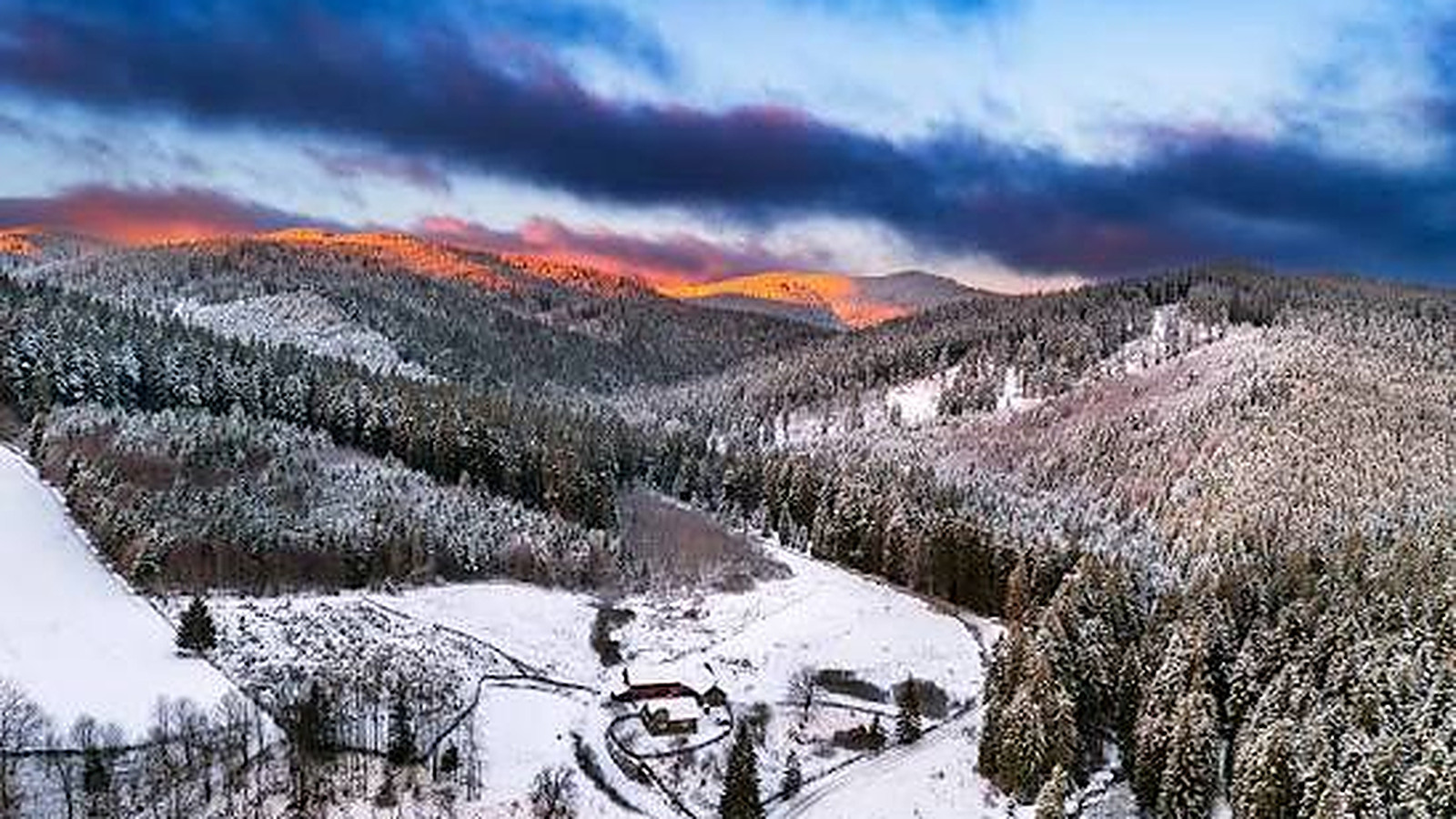
In 1837 the district office in Cernăuți decided to settle the wholly forested valley of the river Humor, until then visited only by hunters and outlaws. A year later a commission of officials looked over the ground. The division of the land, with a German and a Polish part marked out, was recorded in 1842, and the village counts its age from that date.
The division is still visible on the map: above the church live the Romanians, below them the Poles.
In 1842 forty Highlander families from Stara Huta founded the village together with Germans who had come from the Czech lands. The Germans took the upper part and called it Buchenhain, the Poles the lower. The Romanian name comes from a short shepherd called Micu, who owned the clearing with the sheepfold.
In 1930 the village held 1,636 people: 871 Germans, 741 Poles. The church, built in 1894, still stands.
Until 1944 Poiana Micului was a double village: the upper part German, called Buchenhain, the lower Polish. Both Catholic, both going to the same church. In 1930 the Germans were even more numerous than the Poles: 871 to 741.
The Germans left in the wartime resettlements; the Poles stayed, and it was they who rebuilt the burned village. Today's Poiana Micului is that lower half, which took over the whole.
In the spring of 1944 Poiana found itself on the front line. The men had been called up earlier; many did not come back, others returned disabled. In the village there remained women, children and the old.
That night, German soldiers, helped by a Romanian unit, burned the whole village. Nobody managed to evacuate: they fled to the forest in what they had on, and reached relatives in Tereblecea and Bănila. They came back only on the night of 4 to 5 January 1945, to the ashes. Almost everything had burned: the school, the Polish House and the church.
Rozalia Swancar made a song about that night. In Poiana they still sing it, eighty years on. That is the form of memory that has lasted better than documents: not an archive, but a tune each new set of children learns.
One of the few structures escaped the fire: the little house-shaped shrine at the entrance to the village, with an inscription in Polish and in German: „Work all your life, for eternity”. It stands there still and is the most direct witness of Poiana's Polish-German past.
In 2009 the Polish government built a primary school here, where the children learn Polish. It was later named after Krystyna Bochenek, deputy speaker of the Senate and radio journalist, who died in the Smolensk air disaster in April 2010. The school is sometimes held up as a model for other Bukovina villages.
The village has the Obcina Association, chaired by a local man, Łukasz Iuraszek. His greatest achievement is the waymarking of the trails that link the Polish villages with the main sights of the area; the association has also laid out a small campsite.
The Polish House takes guests, and the villagers are glad to rent rooms in their own houses. An evening with the hosts is worth more here than any monument, because Poiana has no monuments: it has people and stories.
The „Mała Pojana” ensemble is active, dancing and singing the Czadca repertoire and, for some time now, Polish national dances too. The village lies in the commune of Mănăstirea Humorului, an hour from Câmpulung Moldovenesc, and is the starting point of a waymarked trail to the peak of Târsiciori.
In 1930 the village had 1,636 inhabitants, of whom 871 Germans and 741 Poles. After 1944, 930 Poles remained, of whom 426 left for Poland.
Poiana is today a mixed village: Romanian above the church, Polish below. The figures cover all inhabitants.
She made a song about the night the village burned. In Poiana they sing it still, eighty years on.
Deputy speaker of the Senate and radio journalist, killed in the Smolensk disaster. The primary school, built here by the Polish government in 2009, bears her name.
Chairman of the Obcina Association. He waymarked the trails linking the Polish villages with the sights around, and laid out a campsite in the village.
A little house-shaped shrine with a bilingual inscription, Polish and German: „Work all your life, for eternity”. One of the few structures that came through the night of 30 April to 1 May 1944.
Built in 1894, burned with the village on the night of 30 April to 1 May 1944, rebuilt twenty years later. It stands where the Polish half of the village met the German one.
Children, young people and adults, often whole families, in three age groups. A Czadca repertoire and, recently, Polish national dances.
The school in Poiana Micului was built partly with money from Poland and is cited as a model for other villages. It is viewed from outside.
The trail from Poiana Micului to Târsiciorian hour and a half, yellow stripe, a view over the Obcina Mare→Czytaj dalej
Your base
Câmpulung Moldovenesc is an hour from the Polish villages and an hour from the painted monasteries. The whole house, seven beds, parking in the yard.